martedì 24 febbraio 2015

The Arch of Janus between lights and images

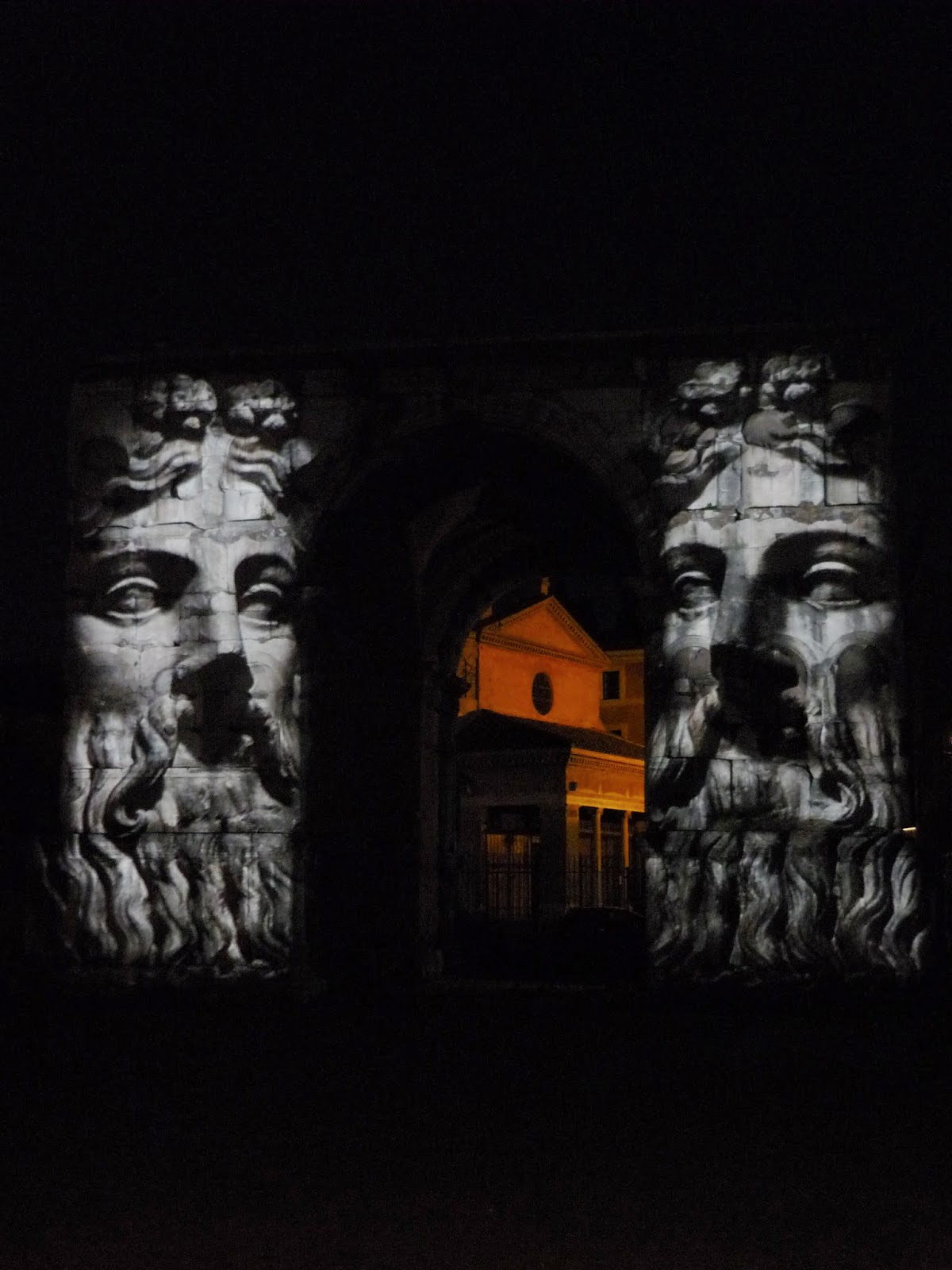
The Arch of Janus, settled near Circus Maximus and the church of San Giorgio in Velabro, houses an unique art show. We are talking about “Populus”, a visual installation about some of the most important ancient Roman masterpieces.
According to the Renaissance tradition, the arch was built in the 4th century AD to celebrate Janus; this is a false belief, because the monument was one of the entrances to the Forum Boarium.

Indeed, Janus was regarded as the watchman of every place with an entrance and an exit (such as the doors); therefore the Latin word “Ianus” was also used to indicate a “door”, or a “covered walkway”.
In the Middle Ages, the powerful family of Frangipane converted the arch into a fortress, which was destroyed in 1830. The top was also torn down because it was
erroneously believed to not belong to the Roman construction.

Today the arch, covered with white marble and supported by four pillars, is unadorned. Thanks to some studies on the monument, we know that it was originally adorned with friezes and four sculptures on the top: the Goddess Roma, Juno, Minerva and Cerere.
Today is the last day to admire the visual installation, do not miss the chance!
Exhibition hours: from 6pm to 12pm


"Populus"
 
"Populus"

"Populus"
 

"Populus"

Arch of Janus


mercoledì 4 febbraio 2015

A touch of Art Nouveau in Rome

Walking through the streets near Trevi Fountain, you can find an unexpected example of Art Nouveau in Rome.
It is Galleria Sciarra (in English: Sciarra Gallery), settled in via Minghetti and commissioned by the noble Maffeo Sciarra to the architect Giulio De Angelis.
He projected, between 1885 and 1888, a structure on two levels supported by columns and endowed by a dome, which is made up of iron and glass.
The inner walls were realized by Giuseppe Cellini, who decided to celebrate “the woman” and her virtues using Art Noveau motifs and classical feature.
The upper decorations represent Pre-Raphaelite
ideal women, but they are portrayed as reassuring brides and mothers; the lower order shows personifications of female virtues, such as "Loyalty, "Patience". The personifications are described through scenes of everyday life, like the garden care or the conversation.
Today Galleria Sciarra is a pedestrian gallery, but in the end of  XIX century it housed the headquarter of the literary magazine “Cronaca Bizantina”, directed by the poet Gabriele D’Annunzio and closely related to the Decadent aesthetic ideals.  


Galleria Sciarra paintings

Details paintings


Dome


Gallery View


Entrance


mercoledì 24 dicembre 2014

Special Christmas tour

We return after a period of absence and what better time than Christmas to walk through Roman streets? Today we suggest a special itinerary leading us to the central city decorated with lights and magical colors.
The walk starts from via dei Fori Imperiali, which connects the Colosseum to piazza Venezia; moving down this road, you can admire two Christmas trees, coming from the Val di Fiemme (in English: Fiemme Valley, which is an area located in the Dolomites mountain), and surrounded by suggestive monuments, such as the Altare della Patria (in English: Altar of Fatherland) or palazzo Venezia.
Continue on via del Corso, one of the main street of the historical centre, and see the bright flags dedicated to the nations which will participate in Expo 2015, the Universal Exposition hosted by Milan from 1st may to 31st October 2015.
Wander the lateral streets near piazza di Spagna, such as via Frattina, via Borgognona and via Condotti, well known for the expensive fashion shops and decorated with bright bells, waves and snakes.
It is time to head off in the direction of Tiber and visit piazza Navona. If you want go back in time, go for a ride on the carousel, and take the chance to see the light show on the obelisk of the central fountain, known as Fontana dei Quattro Fiumi (in English: Fountain of the Four Rivers).
The last stop of our tour is piazza San Pietro (in English: Saint Peter's square), which houses a 25 metres high Christmas tree from Fabrizia, a little town in Calabria.
This tradition was started by Pope John Paul II in 1980 and it is regarded as one the most famous Christmas symbol in the city, as well as the Saint Peter's square Nativity scene.
This year the scene takes its inspiration from "Elisir d'Amore", an opera written by Gaetano Donizetti and settled in an unreal Dutch farming village in XVIII century.
The twenty Nativity characters, donated by a foundation called "Fondazione Arena di Verona", are made of terracotta.
If you visit the square in the late evening or night, do not miss the new ecological lightning system installed on the Dome.
Enjoy it and Merry Christmas!


Colosseum
 
Piazza Venezia

Via Borgognona


Saint Peter's square


Nativity scene of Saint Peter's square 

martedì 14 ottobre 2014

Madam Lucretia and the Talking Statues

In the heart of the city lives one of the most ironic Roman women. We are writing about "Madama Lucrezia" (in English Madam Lucretia), a member of the urban Talking Statues, known as the Congragation of the Wits, which is a group of classical monuments where the Romans posted satirical verses against the politicians.
Lucrezia is a colossal Roman marble torso from the 2nd century A.D, about 3 meters high and settled near the Basilica of Saint Mark.
The work is disfigured but its clothes allow to identify it as Isis (in Italian: Iside), the Egyptian goodness of the fecundity, venerated also in Rome
Indeed the torso may be a part of a colossal statue dedicated to Isis settled in Campo Marzio and moved to the current location in 1500, thanks to cardinal Lorenzo Cybo.
According to the legend, the name Madama Lucrezia comes from "Lucrezia D'Alagno", the lover of Naples king Alfonso V d'Aragona; when the king died, she was forced to run away to Rome, due to Palace hostility.
Throughout the centuries the statue was the protagonist of a carnival ceremony, called "cerimonia dei guitti" (in English: mummer's ceremony). During the rite, every man (usually artists and odd men) chose a woman and showed her to the statue, which was decorated with a necklace made up of garlic and ribbons. The couples started to move around Madama Lucrezia, dancing the "saltarello", a medieval leaping dance coming its name from the Italian verb "saltare" (in English: to jump).
In the centuries the people attached only few satirical verses to the statue, one of them in 1799, when the torso was dropped and someone attached this sheet to her back: "I just can not stand it any longer, about the failed try to establish a Roman Republic.
A last curiosity about Lucrezia! According to a popular tradition, the enormous marble foot, which is located near Palazzo Grazioli, could be a part of the original Madama Lucrezia (goddness Isis) colossal statue. Cinderella lost her shoe?

 
Madama Lucrezia
The marble foot
Il saltarello (medieval dance)
 

lunedì 15 settembre 2014

The Gothic Hall of Santi Quattro Coronati

The Caelian Hill, one of the most famous archeological site in Rome, houses a place known as the Sistine Chapel of the Middle Ages.
It is a Gothic Hall set in the main Tower of a complex called "Santi Quattro Coronati"(in English: Four Crowned Martyrs), a church of  IV century which takes its name from four Christian martyrs killed by Emperor Diocleziano.

This hall is considered an amazing example of Gothic style architecture in Rome and was built by cardinal Stefano dei Conti di Segni, nephew of Pope Innocenzo III and canon of Notre Dame in Paris.
The place is decorated by a cycle of frescoes discovered only in 1996, after being hidden for centuries under successive layers of painting, which were realized in XVI century, when the room was transformed into a monastery's laundry.
According to the critics, the decorations were realized by Terzo Maestro Di Anagni (an anonymous artist) or by Jacopo Torritti (a painter of the “Roman School”) in XIII century.
The frescoes' theme is the relationship between Church and Empire and they represent different biblical characters, such as king Solomon, and members of mendicant orders; but also personifications, such as the Twelve Months, the Arts, the Seasons and the Winds. The Gothic Hall may be visited only by advance booking.
Reservation requests for November 18th and 19th will be accepted from 15th September.

For further information visit the website http://www.aulagoticasantiquattrocoronati.it/

Frescoes of Gothic Hall

Details: Emperor Constantine dreams about S. Peter and S. Paul

Basilica of Santi Quattro Coronati

martedì 5 agosto 2014

Summer Snowfall in Rome!

On every 5 August night the Basilica of Saint Mary Major (in Italian: Basilica di Santa Maria Maggiore), celebrates the fest of Our Lady of Snow, housing a special event called "the miracle of the snow".
Indeed, during this night, the square outside the Basilica is covered by an artificial snowfall (created by the machines) with lights and music.
According to the tradition, on August 5 352 A.D., a roman patrician called John and the Pope Liberius dreamt about the Virgin Mary asking them to build a church in honor of Her.
The next day the Esquilino hill was covered by an incredible snowfall : a miracle which indicated the spot where the Virgin wanted the church.
The Pope and the patrician ordered to build there the Basilica, which was realized by Pope Sixtus III in  432 A.D, maybe over the ancient building created during the Liberius pontificate.
The Basilica of Saint Mary Major is today the largest Catholic Marian church in Rome and includes different art styles.
One of the most interesting place is the Pauline Chapel (in Italian: Cappella Paolina), where the tradition of Our Lady of Snow is still commemorating by dropping white rose petals from the dome during the afternoon of the feast.
The chapel is an important location because of it houses a miraculous Byzantine icon called in Latin “Salus Populi Romani" (in English: deliverance of the Roman people) representing Mary with her son Jesus.
The event starts tonight at 8.30!

The artificial snowfall

Basilica of Saint Mary Major


giovedì 24 luglio 2014

Marforio: from the Roman Empire to the Oscar night

C'è Roma e Roma keeps on writing about the "City Talking statues" known as "The Congregation of Wits",classical monuments where the Romans posted satirical verses against  the politicians (such as nobles families).  
The best friend of Pasquino (C'è Roma e Roma wrote an article about it)  is "Marforio", a marble statue from the I B.C., today settled in the yard of  Palazzo Nuovo (in English: New Palace), a building which is part of Capitoline Museum.
The sculpture represents a reclining bearded man holding a shell on its hand; this iconography allows to identify it as a river god or the Tiber.  
According to the tradition, the name Marforio is a corruption of the Latin inscription "mare in foro" (in English: the sea in the Forum) which decorated a circular basin discovered in the Forum, near the statue.
Another theory explains that the term Marforio comes from the Marfuoli family that lived near the Forum.
In 1558 Pope Sixtus V ordered to move the sculpture to piazza San Marco, where Giacomo Della Porta planned a fountain using Marforio as a decoration; but in XVII century it was relocated in the yard of Palazzo Nuovo.
The basin was used as drinking trough until 1816 when became part of the Dioscuri Fountain, set opposite the Quirinal Palace.
One of the most famous dialogue between Marforio and Pasquino is an invective against Napoleon; indeed during the French invasion of Italy someone posted on the statue a satyric sheet about the French general, accusing him to steal Italian artworks.
(The Italian dialogue is hard to translate in English. It is a play on words in Roman dialect using the verb "steal" and the surname "Bonaparte").
Today Marforio is famed thanks to the Oscar Movie "The Great Beauty" by Paolo Sorrentino.
The international poster is a brilliant photomontage representing the colossal statue behind the main character Jep Gambardella, dressed like a perfect and bored dandy.

Marforio (Palazzo Nuovo)

International poster of "The Great Beauty"